Capsule X
A passive impact capsule for bringing fragile samples back from other worlds. No parachute and no propulsion: a triangulated aluminium lattice and layered thermal protection take the landing, so the sample doesn't.
Land hard, keep the sample perfect
As NASA returns fragile samples from celestial bodies at high velocity, it needs a passive, lattice-based impact capsule that absorbs extreme landing forces and delivers the samples intact, sealed and uncontaminated.
- Sample
- Must stay fully intact, with no damage at all.
- Seal
- No breaches and no contamination.
- Passive only
- No propulsion and no active mechanisms.
- No deceleration aids
- No parachutes or deployable decelerators.
- How
- Impact mitigation has to come from structure, material and geometry alone.
From springs to a lattice
Every concept kept the same idea: hold the sample canister at the centre and put as much energy-absorbing structure as possible between it and the ground.
Canister on springs
The first sketch suspends the sample canister on springs inside an egg-shaped shell, so the shell can decelerate while the springs soften the jolt.
Fill the shell with lattice
The canister sits inside a dense lattice that fills the shell. A lattice crushes instead of bouncing, so the energy goes into deforming struts.
Lattice core, braced frame
A lattice core around the canister, held inside a geodesic outer frame by radial struts. Two stages: the frame takes the first hit, the core takes what is left.
Designing the lattice cell
We sketched the triangular pattern to a 20 cm limit, then mirrored the original section to build out a symmetric layer, before modelling it in CAD.
Capsule X
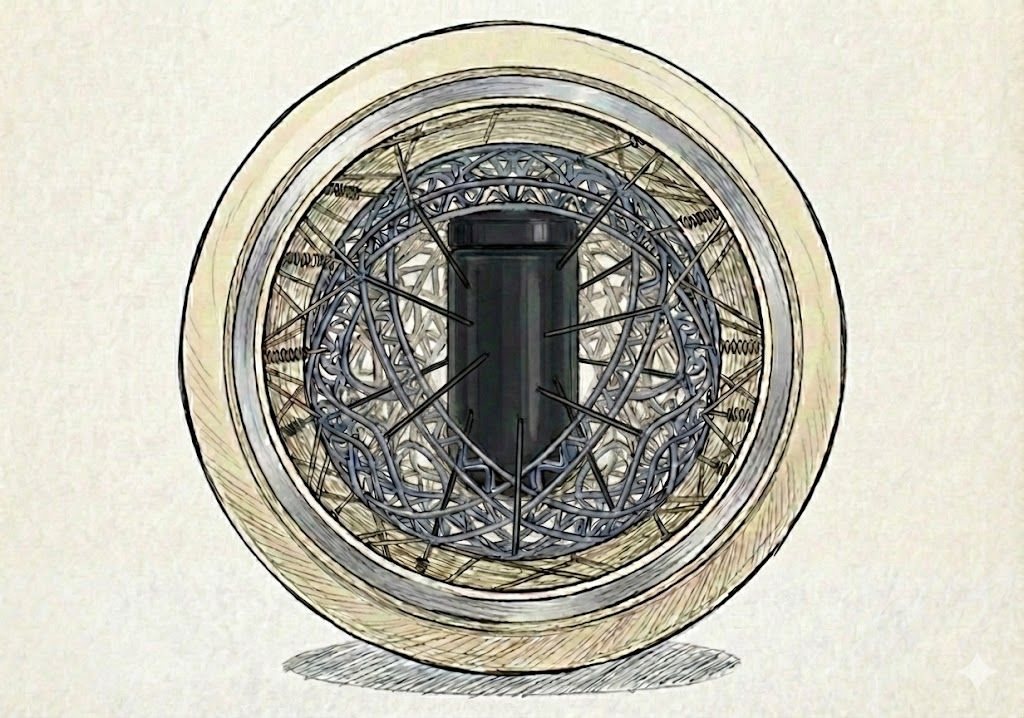
The canister sits at the centre of a spherical lattice cage, tied to a layered outer shell by radial struts. The shell handles heat; the lattice handles the impact.
Spread the hit over every strut
A triangulated lattice can't change shape without stretching or crushing its struts, so a load at one node is shared out through the whole structure instead of punching through. Click any node along the top to drop an impact there.
An illustration of how load spreads through a triangulated lattice, row by row. It is not a simulation of our capsule's forces.
Triangulation
A triangle is the only polygon that can't deform without changing a side length. Built from triangles, the lattice is stiff and every strut carries pure tension or compression.
Load sharing
Each node passes load to several neighbours, so the force per strut drops as it travels toward the sample instead of concentrating in one path.
Absorb, don't bounce
Ductile struts can yield and crush progressively. That turns impact energy into permanent deformation of the lattice rather than rebound into the sample.
Four layers, four jobs
From the outside in, each layer protects the one inside it. Select a layer to see what it is and why we chose it.
Three engineers, three roles
Krrish Shah
Mechanical Systems Engineer
Dhruvil Shukla
Materials and Product Engineer
Ved Lakkad
CAD and Design Engineer
Sources we used
- NASA, “Museum in a Box: Structures and Materials, Space Shuttle Tiles” (grades 9–12).
- Ryerson, “Grade Anatomy: Aluminum 6061” (2024).
- ASM Aerospace Specification Metals, Aluminum 6061-T6 material data sheet (2024).
- Darshan Safety Zone, “Ceramic Fibre Cloth” product data (accessed Jan 2026).
- A. Tikkanen, “Silicon,” Encyclopædia Britannica (2019).
- R. Alanis, “Sample Return Capsule Landing (Artist's Concept),” NASA Science (2005).